





Many of us learned that lift results from the Bernoulli principle, which states as speed increases air pressure decreases. This explanation suggests the air over the wing travels faster because it has farther to go over the longer, curved wing top than underneath along the shorter, straight bottom. This faster flow creates a low pressure zone which sucks the wing up. This explanation of lift has fooled a lot of people like me, assuming there are people like me which I won’t go into.
Unfortunately, this simple idea defies the laws of physics. Paraphrasing Newton: a body in motion remains in motion and a body at rest remains at rest unless acted upon by an outside force. In other words, changing something’s speed or direction, its momentum, requires a force.
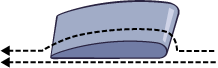
The explanation of lift above claims the air speeds up because of the greater distance over the top. If you think distance creates force, try hitting a baseball with a yard and see how far it goes. Not a yard of something, but a yard. Force comes from something that physically exists, distance is a non-physical measurement and so cannot create a force. An electric fan blows air across a big room or a small room at the same speed. It’s the force from the fan that matters, not the distance. Air doesn’t know it has farther to go and so decides to speed up. There is no force of distance.
The air does travel faster over the wing than under, but it is not because of different distances. Thing is, the curved upper surface doesn’t create lift at all, it has a different purpose altogether. More on that later.
Before getting down to the nitty-gritty you may want to first read our related introductory articles. They could be read after, too:
A Simple Way to See How Planes Fly
Bad Lift Demonstrations Corrected
The Trouble with Airflow Diagrams
The accepted explanation of lift is the Lanchester-Prandtl hypothesis of flying. It involves, to quote one expert, “a bound vortex, tip vortices and the starting vortex all of which, in plan view, form the ring vortex formed just before takeoff…” in other words, a lot of complex stuff I have a hard time explaining. Especially since I’m no aero-engineer.
The airflow diagram commonly seen with many explanations of lift can be misleading because it’s the wing that moves through the air, not the other way around. The pilot travelling with the wing sees airflow, an observer on the ground sees the wing moving. Actually the whole plane, but you get the idea.
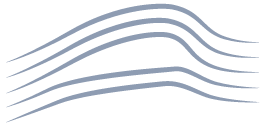

Your typical airflow diagram (above) shows air flowing around a wing. This is how it looks from the point of view of the wing which sees air moving around it. That is, if a wing could see and air were visible. This is misleading because in this case the thrust is on the air rather than on the wing, which isn’t how planes usually do it. The air’s front to back movement is from thrust, the up and down movement is from the wing. As you will see, lift is from forcing air down, not back.
An easy way to visualize the wing moving rather than the air is to compare a plane to a helicopter. The spinning chopper blade, which is simply a rotating wing, pumps air down which propels the blade up. The air isn’t sliding over and under and jetting off to the side as you might infer from the airflow diagram, it goes down. An airplane wing does the same thing, it pumps air down, only the wing moves in a line rather than a circle.
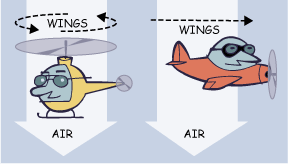
This pumping air down in both cases is called downwash. The return force on the rotor or wing is lift. Making the connection between downwash and lift, and how downwash is produced is the key to understanding how planes fly. Once you see that, it’ll all seem so simple. More or less.
At the risk of getting sidetracked, where does the air pumped down by the helicopter come from? From above, not from the side. So where do you suppose the air pumped down by a wing comes from? As you might suspect, it comes from above. The tricky bit is understanding just how a wing does this.
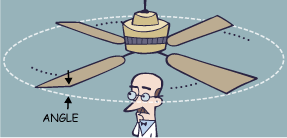
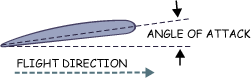
The short answer is the angle of attack. The simplest way to look at it is to compare a wing to a ceiling fan. Notice the fan blades are angled, they don’t spin through the air flat on. That’s how a fan blade moves air around and so does a wing. A fan blade does this without a curve, only an angled blade. In other words, with an angle of attack.
Actually, you can get a flat wing to fly if you have enough thrust or if the plane is very light, (a high power to weight ratio) as long as you have an angle of attack. The toy balsa wood planes I had as a kid flew with flat wings. But a flat wing doesn’t do a very good job of it. It’s pretty hard to get a ceiling fan to fly like a helicopter, while it doesn’t take much lift to get balsa wood off the ground.
On an airplane wing the leading edge is higher than the trailing edge in the flight direction giving it an angle of attack. This means the air hits the oncoming wing on the leading edge and along the bottom. This creates a vortex of air that…
Though many explanations start with airflow, getting into the details of this right off the bat is not as helpful as may be supposed. While airflow is informative and important, it’s describing air movement rather than lifting forces. What your Average Joe and Jane really want to know is how lifting forces are put on the wing. Let’s digress a bit.
There are a few basic Newtonian principles to keep in mind. One, a body in motion remains in motion and a body at rest remains at rest unless acted on by an outside force. Two, for every action there is an equal and opposite reaction. Three, acceleration is proportional to the force applied.
The first one we touched on earlier with the idea that a force is needed to change something’s momentum, altering direction or speed. Air particles can’t turn corners, speed up or slow down on their own, something makes them do it. Even something not moving has momentum, zero momentum. It takes as much force to speed a car up from zero to 60 as to stop it at 60 mph.
Action and reaction we’ve all heard about. A billiards example is a cueball smacking into a red ball sending it flying. The momentum force of the cueball is imparted to the red ball accelerating it. At the same time, the red ball, which was at rest, imparts an equal and opposite reaction force on the cueball stopping it.
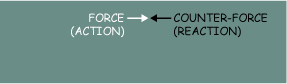


Click pic to play animation
The third principle tells you the more force the cueball puts on the red ball the more it accelerates, or changes momentum, and so the more reaction force is put on the cueball stopping it. If you saw only the red ball rolling away and knew it was resting a moment before, its speed would be evidence of how much force it encountered, and how much reaction it responded with. It should be easy to tell the bottom red ball took the bigger hit from the cueball, and returned the bigger favor.
Now, we’re talking about wings and not how to play snooker, but the same Newtonian rules apply. Since we’re moving a wing up, or at least trying to keep it aloft against the pull of gravity, we need a force to do that. Just like air, a wing can’t do it of its own volition.
We need to take a leap of understanding and not think about lift only in terms of airflow, but also in terms of force. Think of airflow as evidence of the force the wing applies to the air, and the reverse as evidence of the reaction force the air puts on the wing.
Something moving through a liquid or gas circulates the medium around it. Drag your finger through some sand and compare that to your finger going through water. In the sand you leave a groove, in the water you don’t. You can’t cut a groove in a liquid or gas, it will flow back in filling the groove. This is what the expression, “nature abhors a vacuum” is about.
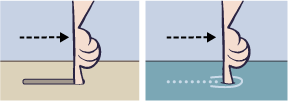
Now, nature doesn’t really have any emotional response, but in a closed system under pressure gasses and liquids follow the path of least resistance filling any void they can get to. (By the way, the entire Earth’s atmosphere is a closed system under pressure.) This flowing behavior of gasses and liquids, which is about fluid dynamics, means instead of leaving a groove you get a vortex.
The vortex is a chain reaction amongst the water molecules circulating around your finger. The flow, circulation, or movement of water is called convection. The force from your finger pushes water out of the way in front and other water flows into the potential void your finger creates. The chain reaction due to force through the water is both convection and a pressure wave, diffusion. Diffusion can be likened to billiard balls hitting each other.
For instance, say you have a line of 2 red balls and a black which are struck by the cueball as shown below. The action of the cueball puts a force on the first red which is transferred through the second red and to the black which flies off. The reaction of the black, which was at a standstill when this all began, puts an equal and opposite force on the red so it doesn’t fly off. The second red stopped the first red which stopped the cue ball.
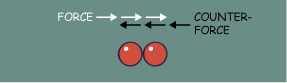

Click pic to play animation
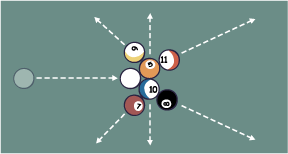
The more balls you add in the mix the more complicated it gets. If you’ve ever seen the trick shot of pocketing 6 balls at once you know what I mean. The cueball slams into the cluster, the energy is imparted and transferred through the balls so they each fly off in different directions. So even though the initial force from the cueball is in one direction, the diffusion can send the balls in various directions depending how they line up and what they run into. The reaction on the cueball is directly opposite of the force it imparts on the balls it contacts, what happens after doesn’t change that.
Let’s get back to the angle of attack and see how this all applies. Take a shallow baking pan and sprinkle it with pepper. Hold a flat metal plate (or whatever is handy and preferably waterproof) upright with the bottom edge flat against the pan and at a slight angle, simulating an angle of attack. Draw it across the pan as shown.
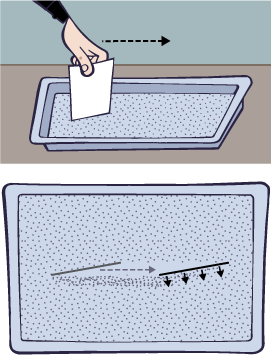
The plate scoops out a void pushing the pepper to the side which accumulates off what would be the underside if you look at it that way. It’s easy to see the force of the plate on the pepper is down and slightly forward, pretty much perpendicular to the face of the plate. This is a fair indication of the direction of force from the plate to the pepper. This direction of force is the same whether pushing on pepper or a liquid or gas. And the reaction in the opposite direction, up and slightly back, is the same, too. Notice as well, the upper surface does not move any pepper. The bottom surface and leading edge cause all the motion.
What’s different about fluid media, like water or air, is the diffusion of the force which forms a vortex. Fill the pan with about a quarter inch of water and sprinkle pepper over the surface. (The pepper helps you see the action of the water.) Draw the plate across the pan through the water the same as before and watch the action around the plate.
You’ll see a swirling at the leading edge, the water flows up and around and down something like indicated by the picture below. It doesn’t exactly split at the leading edge, going over and under as the airflow diagrams seem to suggest. It doesn’t leave a void behind, either. It forms a vortex.
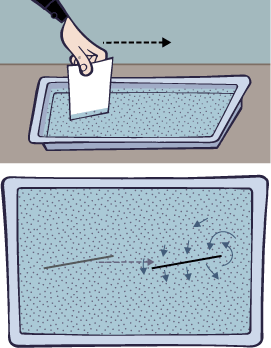
Just like with the pepper, the force from the plate on the water is down and slightly forward, and the reaction in the opposite direction, up and slightly back, is the same, too. The water flow “above” the plate is down, even at the trailing edge. As with the pepper, all the action comes from the leading edge and underside of the plate, including the action through diffusion over the top. It’s all one vortex.
(If you try this test and find it subtler than depicted, it’s a vortex nonetheless. A vortex always forms when anything passes through a liquid or gas. It’s one of those immutable laws of science you hear talked of.)
This gives you an approximation of how a wing works. Of course a wing moves a lot faster and the vortex is much more dynamic, but at subsonic speeds it’s similar. I say subsonic because the chain reaction, the diffusion of force through the medium is at the speed of sound. Which only makes sense because sound travels in waves through a medium by the same process of diffusion. The speed of sound and the speed of diffusion are the same thing.
Here’s where it gets a bit tricky. When sound travels through the air, the bit of air vibrated at the source doesn’t fly all the way to your eardrum where you hear it. The energy is transferred by diffusion in sound waves through the air. This same sort of thing happens in that swirling action at the leading edge of a wing.
Take two billiards examples like the ones below. On the top the cue ball hits the yellow ball into the rail where it rebounds to the second rail and off again to where it hits the black ball accelerating it down and back toward where the cue ball started. The yellow ball makes the circuit around to the black at the speed of travel. Call this convection.
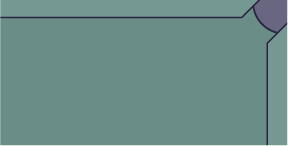


Click pic to play animation
In the second case there are four red balls along the path where the yellow ball traveled as above. The cue ball hits the yellow ball into the first red ball sending a force through the series of red balls to the black accelerating it down and back in the same manner as above. The yellow ball itself doesn’t travel around, but the force does. This is like diffusion.
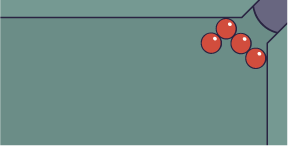
Click pic to play animation
See the black ball move off at the end of the line? Diffusion leads to convection, they go hand in hand, despite not actually having limbs of any kind. Also notice the force travels through the red balls by diffusion faster than the yellow ball travels by convection.
Something along these lines happens with a wing. So even though the air doesn’t make the trip around in a circle at the leading edge, the force does. This can be expressed as, “diffusion dominates over convection.” Diffusion is the flow of force, or pressure impulse. Convection is the actual movement, or flow of air.
A wing moving through the air creates a vortex. Lift begins with thrust, it’s the forward movement of the wing which creates airflow. Without getting into the heady details, the vortex remains with the wing as it passes through the air. It is referred to as the bound vortex because it is attached, or bound to the wing as it travels. New air constantly passes through yet the action and forces of the vortex remain bound to the wing.
The direction of the forces on the air through diffusion from a wing in flight is something like the diagram below. Notice the similarity to the pepper water test it is, only bigger and more dynamic.
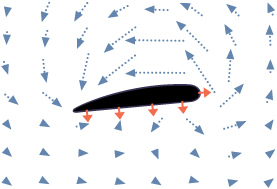
Don’t be mislead by the diagram which is not showing airflow (convection), but rather the direction of force diffussion. The force of acceleration is in a straight line, just like momentum, though the actual air movement is not.
This chain reaction, the diffusion of force starts from the forward motion of the wing. The red arrows indicate the direction of force from the wing. The blue arrows are the direction of force by diffusion through the air. The longer arrows show where the air is accelerated the most. The more the air is accelerated indicates more work is being done in that area and less in areas where there’s less acceleration.
The force through the air represented by the blue arrows in the above diagram comes from the wing, and so there’s an “equal and opposite reaction” from the air on the wing. By pretending to reverse the direction of the force we can picture the reaction pathway shown by the gold arrows back to the source, where the force is first applied. As you can see the reaction from the air on the wing is back at the leading edge, that’s drag, and up on the underside, that’s lift.
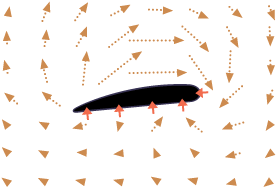
Mouse over to compare the action and reaction
What’s kind-of confusing is there’s more acceleration of air over the top of the wing than below. The wing gets more lift from pumping air down from above the wing than from pumping air down beneath. So, even though what gets the ball rolling is underneath, most of the work on the air is done above. Strange but true. Anyway, this is basically how downwash is created and why most of it comes from above the wing rather than below.
This is where the wing’s curve, or camber, comes into play. It’s not to increase the distance of airflow. Basically, the curve is shaped to conform to the natural curve of the bound vortex so it doesn’t disrupt the natural curved path of the circulation around the wing. Since lift comes via the bound vortex, cooperating with the circulation in the vortex is important.
In everyday language it means airflow doesn’t curve to match the shape of the wing, the wing is curved to match the shape of airflow. How the camber effects all this is complex and hard for me to explain, but because it doesn’t actually create any lift we’ll just leave it at that.
Changing the angle of attack changes the force of lift. It’s not just that the counter-force is pushing more against the direction of travel increasing drag. Take the pan of pepper water with the plate moving at a more severe angle and notice the different motion in this case. Instead of the water going down at the trailing edge, there is another swirling around as at the leading edge.
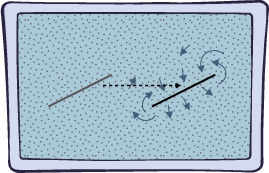
What this means for a wing is that there is less acceleration of the air down. This indicates less downward force on the air, less downwash. And so also less counter-force on the wing up, less lift. Take that far enough and you get what pilots call stall. (And passengers call scary as all getout.) So instead of flying, you’re just falling. Gravity is the one force that never changes.
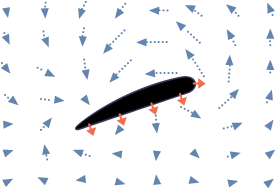
Now I admit it’s not really as simple as that (if you call all that simple), there’s drag, stagnation points, wingtip vortices, and other confounding things that only an aeronautical engineer could explain. Suffice it to say, the role of the upper surface curve isn’t what people usually think it is, but it makes a difference. Understanding just how and why the vortex forms as it does virtually takes a rocket scientist. Since I’m not, I’ll let it go. (If you really want to get into all the details as explained by an actual expert, follow the link at the bottom of the page.)
With the air moving instead of the wing, trying to visualize lift with airflow is like trying to understand a ceiling fan while riding on a fan blade. Below, the little man on the blade feels a wind blowing sideways in his face, and to him the room appears to be spinning. Hard to understand downwash this way, besides getting dizzy from the ride. Meanwhile, the little man standing below the fan feels a wind blowing down on the top of his head. Yeah, it helps he’s bald. Still, this guy can readily understand downwash.
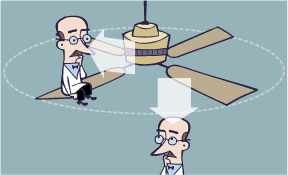
Now that we understand how downwash and lift go hand in glove, we can see why your typical airflow diagram is not all that useful – it doesn’t emphasize downwash at all. In fact, most of the downwash is missing, it happens off the end of the diagram (A). What’s also noteworthy is what happens in front of the wing, how the airflow bends upward (B). This indicates the wing is generating a force on the air before it gets to the wing. As you’ve already read about the bound vortex and all that, you understand how that happens.


Still, we’re looking at air moving backward and not the wing moving forward. Below is a simple animation of a plane flying through vertical smoke plumes generating downwash to give you a basic idea of what all the above in action looks like.


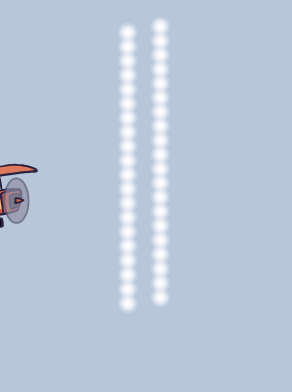
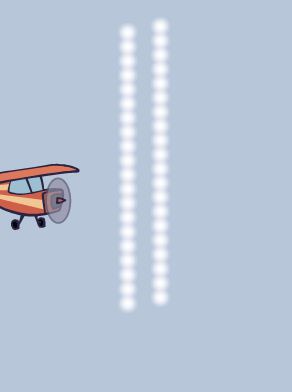
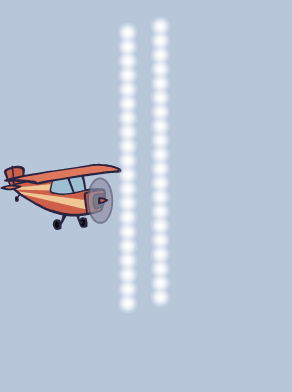
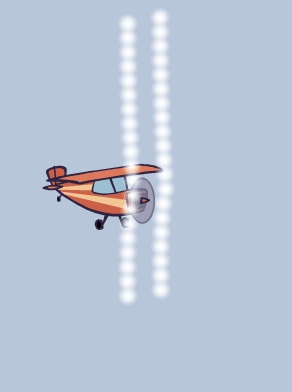
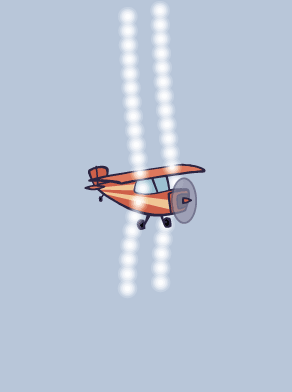
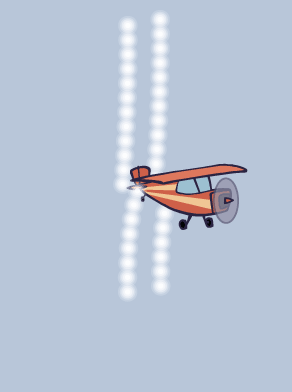
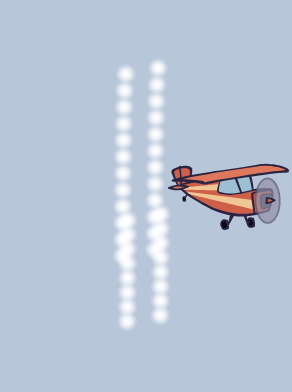
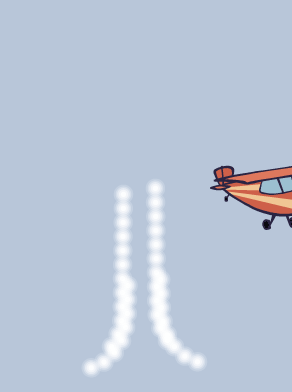
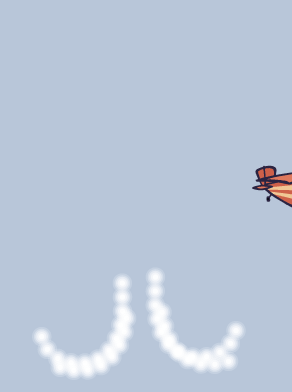







Click pic to play animation
Lift is a product of force, it all starts with the initial force of thrust. (In airflow diagrams the thrust is on the air rather than the wing which can confuse things.) It’s your beginer’s Newton, action and reaction and all that. On a basic level you can say thrust pushes the wing with its angle of attack into the air ahead forming a vortex. The vortex scoops air over top and pumps it down past the trailing edge to below the wing. That’s downwash. The reaction to downwash is lift. Add it all up you get forward motion and it flies.
To give you an idea of how much air is pumped down from above the wing as downwash, a small four-seater plane like a Cessna 172 pumps five tons per second in level flight. That’s all the air from 18 feet above the wing. That’s a lot of downwash. This should give you some notion of the power of the forces involved. As well as the size of the vortex which is much bigger than a few streams of air you see in your usual airflow diagram.
The trick is not to think of lift in terms only of airflow or pressure differences, but of force. The picture below is not a diagram of how it works, just something in the way of a visual aid to show how it appears to work. Thrust moves the wing forward creating downwash. The equal and opposite reaction to downwash is lift.
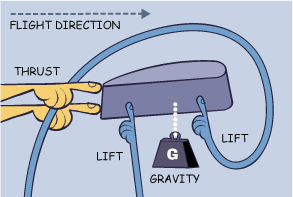
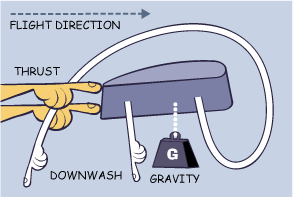
Mouse over to compare downwash and lift.
Now, analogies and metaphorical pictures can be misleading, but that’s the basics, more or less. Should anyone question you on this, just say it’s the Lanchester-Prandtl hypothesis of flying. This may not mean anything to anyone unfamiliar with it, but you’ll sound impressive just as if you knew all about it. (Rather like me, actually.) If the only thing you take away from this is rejecting the old incorrect notion of lift being created by the Bernoulli principle or the wing’s curve, then maybe I’ve done something worthwhile.
© Terry Colon, 2017
Special thanks to fluid dynamics engineer Terry Day whose invaluable assistance, and patience, helped me understand it. His site:
Other bits from the flying files:
A Simple Way to See How Planes Fly
The Trouble with Airflow Diagrams
A more detailed, comprehensive explaination of lift from another source:
If you tuned in for our how planes fly bits, you might like our take on bicycles:
